Product Management Toolkit: EP. 1 – Ruthless Prioritisation
A Practical Guide to Product Prioritization for PMs, Founders & Growth Teams—Frameworks, Case Studies, and Real-World Tactics to Make Better Roadmap Decisions

Why I’m Writing This Toolkit
Welcome to the first edition of the Product Management Toolkit – a series I’m curating to demystify key PM practices, one concept at a time. Whether you're an early-stage founder, a PM, someone seeking to upskill, or just someone trying to manage multiple hats at once, this toolkit is your pocket-sized field guide to sharper decisions and smarter builds.
But this isn’t just for you – it’s for me too. As someone who thrives on structured learning, this is a way to revise the fundamentals and stay honest about how I apply them. Especially as a product-led operator, I often revisit core principles when I’m balancing roadmap priorities, stakeholder inputs, user demands, and growth goals. This 10-part publication is part documentation, part revision, and part community building. My hope? That it becomes a go-to reference for someone juggling priorities and seeking clarity.
And what better way to begin than with a principle that’s both elegant and brutal: ruthless prioritisation.
What Is Ruthless Prioritisation (and What It’s Not)
Imagine this: you’ve got 10 product ideas. All decent. Some exciting. But your bandwidth? It could barely handle two.
Ruthless prioritisation means picking the top two, killing the rest, and executing those two like your survival depends on it. (Because in many cases… it does.)
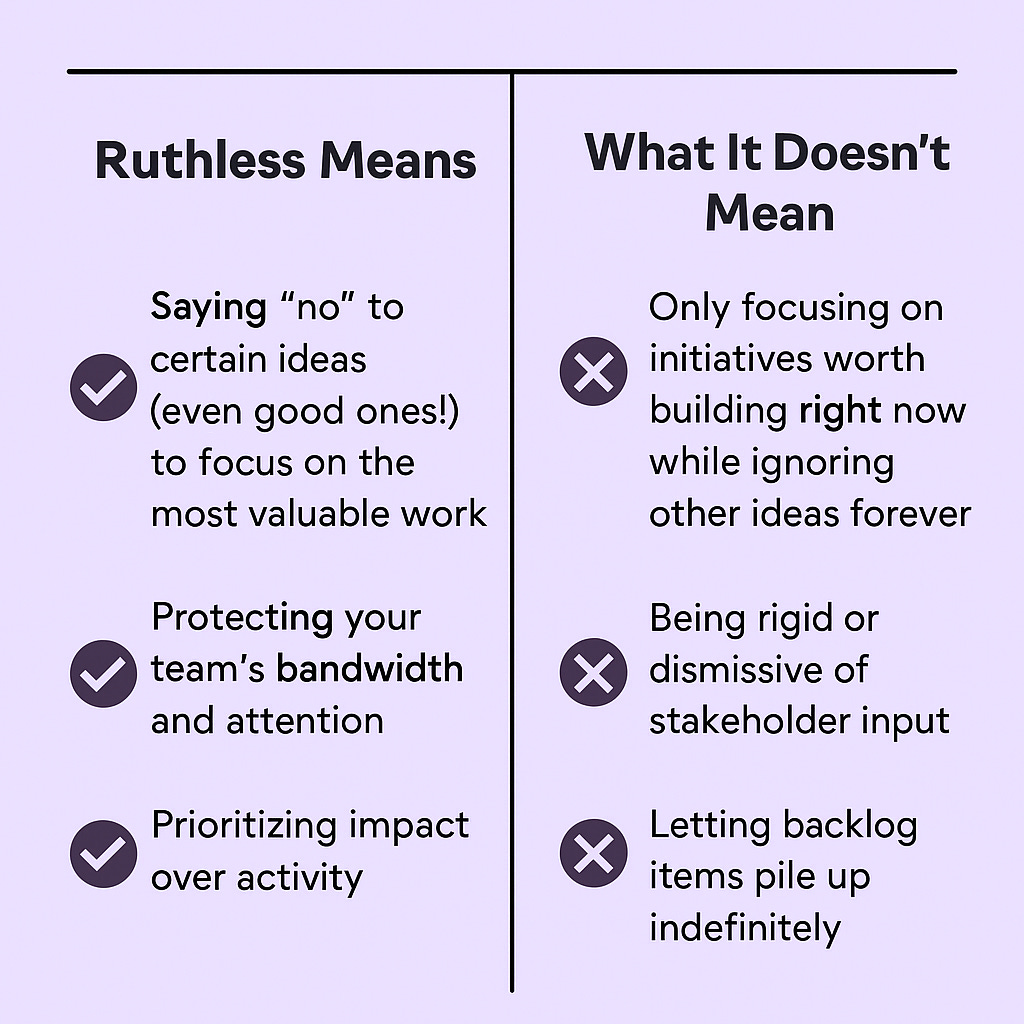
Essentially, it boils down to the art of saying "no"—even to good ideas—in order to execute the great ones. It’s not about rigidity. It’s about intention. About protecting the scarce bandwidth of your team. About being clear on what will truly move the needle.
✅ What It Means
Saying “no” to even good ideas to protect your focus and impact
Prioritising value over volume, outcome over activity
Respecting the limited attention and energy of your team
🚫 What It Doesn't Mean
Ignoring ideas forever
Disrespecting stakeholder inputs
Getting paralysed by indecision or rigid frameworks
"If you can't do all ten, do the top two really well." — Sheryl Sandberg
Real-World Case Studies
🍏 Apple (1997 Turnaround)
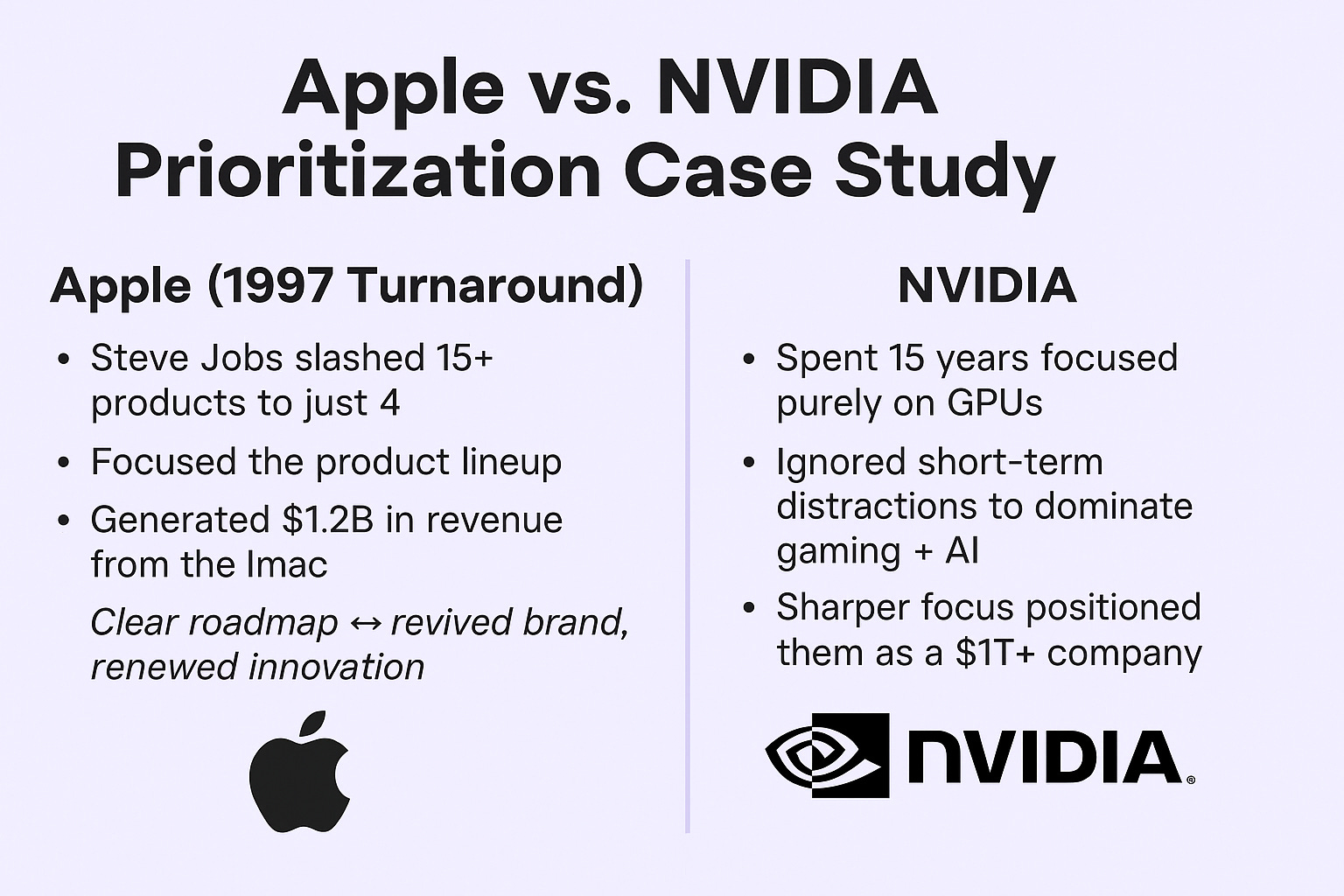
In 1996, Apple was floundering. It had posted $1.04 billion in losses and was 90 days from bankruptcy. Their product catalogue was bloated with 15+ computer models and several confusing accessory lines. Teams were stretched, product positioning was unclear, and customers were lost. The company's leadership was just as fragmented. Steve Jobs, the visionary co-founder who had been ousted from Apple by CEO John Sculley back in 1985, was nowhere to be found. Since Jobs’ departure, Apple has cycled through two CEOs, neither of whom could replicate the drive, creativity, and success that had once made the company a leader in innovation.
At this crucial juncture, Steve Jobs returned in 1997 as interim CEO. His task was simple to phrase but seemingly arduous to accomplish: Rebuild Apple’s product strategy, re-establish brand clarity, and rescue the company from financial collapse.
His first move? Slash the product line to just four SKUs:
Consumer desktop
Consumer laptop
Pro desktop
Pro laptop
This wasn't just cost-cutting. It was ruthless prioritisation.
With fewer distractions, Apple’s engineering and design teams focused all their energy on a single product: the iMac. That freed up energy and budget to create the iMac, which earned $1.2 billion in its first year.
This focus on fewer, better things laid the foundation for Apple’s later hits: iPod, iPhone, iPad.
🔁 From bloat to brilliance, driven by hard decisions.
💻 NVIDIA’s Relentless Focus
In 1995, NVIDIA launched NV1, its first graphics card. It flopped. It tried to do too much (3D graphics, sound, Sega Saturn compatibility) and ended up doing little well - the NV1 graphics card attempted to cover many functions, but it didn't excel at any of them (became a “jack of all trades, master of none”—which, in hardware markets especially, usually spells failure). What stared the fledgling startup right in the eyes was a near-bankruptcy experience in 1996 when the company was on the verge of missing payroll and had to lay off a significant portion of its staff.
The infamous unofficial company motto was coined at the advent of the failure "Our company is thirty days from going out of business." (Later, it became a sort of totem pole, helping shape Nvidia's culture of urgency and focus, which contributed to its later success.) However, the leadership remained steadfast in their vision and focused all their energy on building a stronghold in the GPU space, while also surviving against giants like Intel and 3dfx.
Instead of pivoting wildly, NVIDIA narrowed its focus. They doubled down on GPU innovation:
Released RIVA 128 (or "NV3", a consumer graphics processing unit created in 1997 by Nvidia. It was the first Nvidia product to integrate 3D acceleration), a massive success
Pioneered programmable shaders with GeForce 256 (the first "GPU" - graphics processing unit)
Created the CUDA architecture (a software layer that gives direct access to the GPU's virtual instruction set and parallel computational elements for the execution of compute kernels), allowing GPUs to be used in AI and scientific computing
Landed the Xbox (Microsoft’s gaming console) GPU contract (a big financial win and validator)
Even as Intel tried to dominate, and ARM reshaped mobile, NVIDIA stuck to its lane — and owned it.
NVIDIA spent 15 years laser-focused on GPUs, despite trends pulling other companies toward CPUs, chipsets, and consumer gadgets.
Instead of chasing every opportunity, NVIDIA kept refining its GPU technology. That decision paid off: they now dominate AI infrastructure and gaming graphics, and are one of the few companies to cross the $1T valuation mark.
🎯 Focus wasn’t a constraint—it was a multiplier.
Prioritisation Frameworks
1. RICE (Reach, Impact, Confidence, Effort)
Score = (Reach x Impact x Confidence) / Effort
Quantitative model used to score ideas.
When to use: Roadmap planning, data-backed prioritisation.
✅ Pros: Quantifiable, consistent
❌ Cons: Needs clean data, may ignore qualitative insights
Example:
You’re evaluating two features:
Feature A: Referral program
Feature B: New dashboard
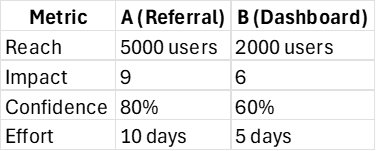
Feature A RICE = (5000x9x0.8)/10 = 3600
Feature B RICE = (2000x6x0.6)/5 = 1440
✅ Build the referral program first.
2. MoSCoW (Must, Should, Could, Won’t)
A prioritisation framework that groups backlog items into urgency categories.
When to use: Sprint planning, cross-team negotiations.
✅ Pros: Simple, effective in group settings
❌ Cons: Subjective if not backed by metrics
Example:
You’re building a V1 mobile app.
Must: Login, Signup, Booking flow
Should: Profile photo, Feedback form
Could: Dark mode, Language toggle
Won’t: In-app gamification (for now)
✅ Helps you manage scope in MVP and manage stakeholder expectations.
3. Value vs. Effort Matrix
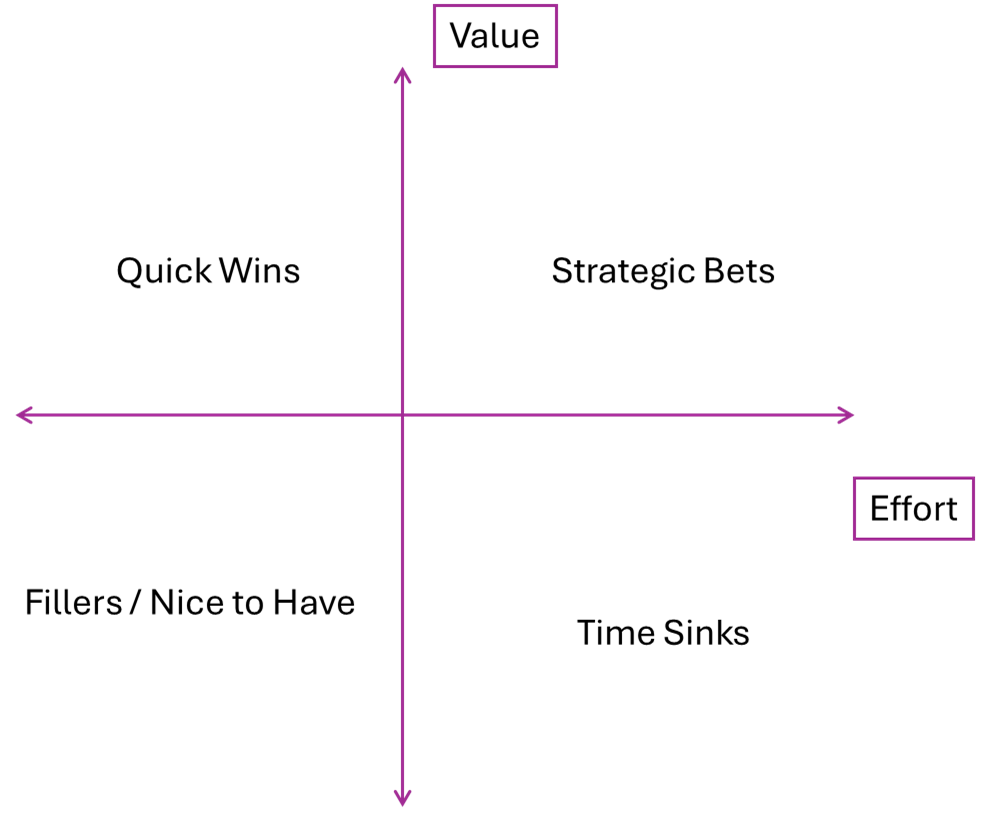
Plot ideas on a 2x2 grid (High/Low Value vs. High/Low Effort)
Visual framework to balance low-hanging fruit with strategic bets.
When to use: Design sprints, ideation workshops.
✅ Pros: Great visual clarity, fast
❌ Cons: Doesn’t scale for complex portfolios
Quadrants:
High Value, Low Effort: “Quick Wins”
High Value, High Effort: “Strategic Bets”
Low Value, Low Effort: “Fillers / Nice to Have”
Low Value, High Effort: “Time Sinks”
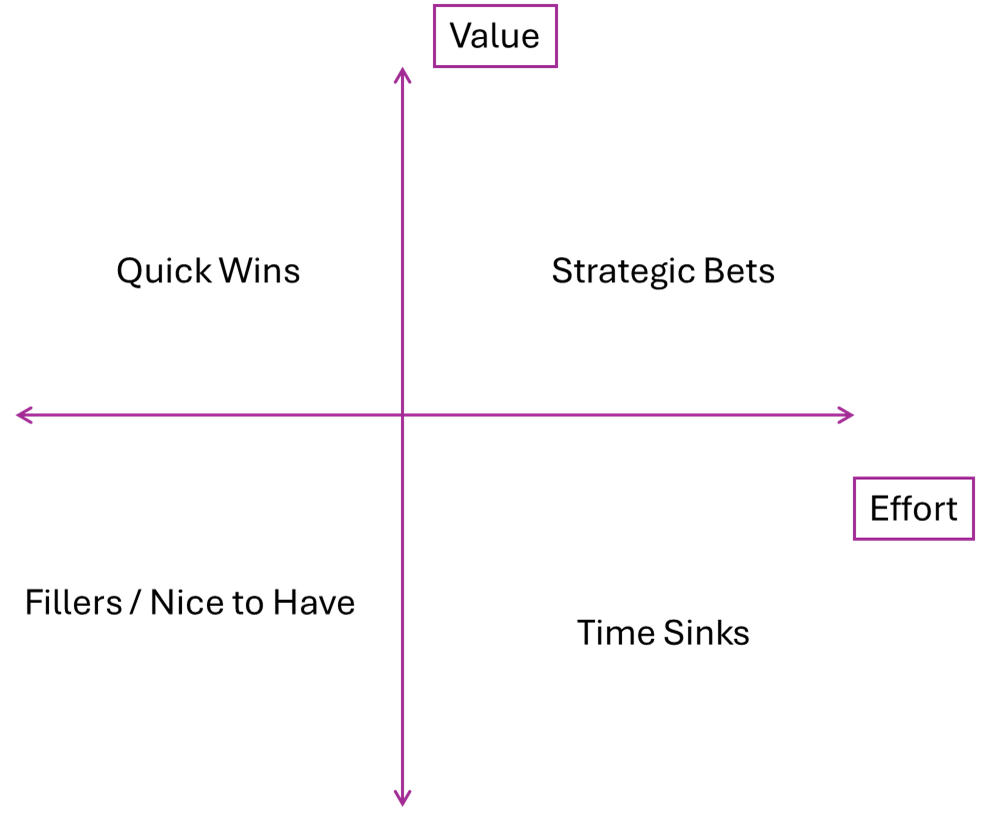
Example:
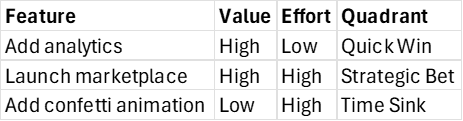
✅ Do the "Quick Wins" and "Strategic Bets" first. Ignore Time Sinks.
4. Kano Model
Classify features as:
Basic (expected)
Performance (more is better)
Delight (surprising, wow factor)
Categorises features based on customer delight and satisfaction.
When to use: Discovery and UX-heavy projects.
✅ Pros: Builds differentiated products
❌ Cons: Needs deep user research
Example:
Basic: Password reset
Performance: Faster checkout
Delight: Birthday coupon with a personal message
✅ Ensure you never skip basics but sprinkle in delight.
5. Opportunity Scoring
Rank based on how important the feature is and how poorly it’s served.
Ranks features based on how poorly they’re satisfied today vs how important they are.
When to use: Post-survey analysis, user research synthesis.
✅ Pros: Grounded in user data
❌ Cons: Time-intensive, research-heavy
Example:
Survey shows:
Feature X: Importance 9, Satisfaction 3
Feature Y: Importance 6, Satisfaction 5
Opportunity = Importance - Satisfaction
Feature X: 6 (✅)
Feature Y: 1 (not urgent)
✅ Fix Feature X to improve retention.
6. Value vs. Risk Matrix
Perfect for product bets, compliance-heavy builds, or big launches.
Helps balance value against risk, rather than effort.
When to use: Product bets, launch decisions.
✅ Pros: Good for strategic bets
❌ Cons: Needs risk mapping discipline
Example:
Idea A: Add crypto payments (High Value, High Risk)
Idea B: Add chatbot FAQ (Medium Value, Low Risk)
Use risk-mapping to derisk Idea A (through legal review and staged rollout), then evaluate whether it moves up the priority queue.
🔄 How to Decide Which Framework to Use?
Think of these frameworks as lenses, not commandments. Depending on the context, you’ll zoom in or out:
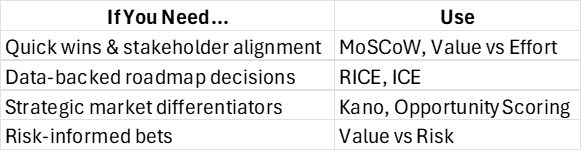
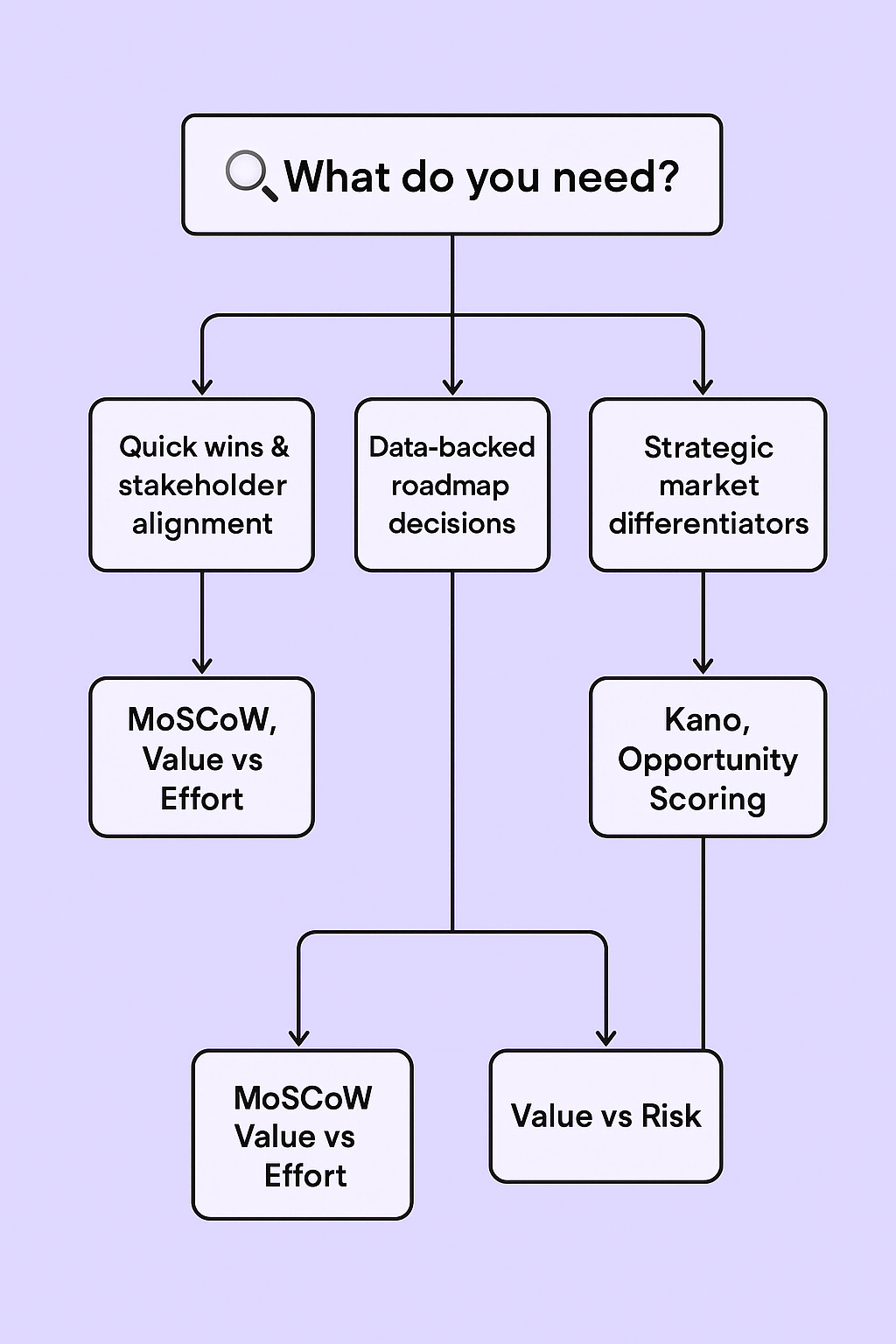
TL;DR: Say No (So You Can Say Yes, Properly)
Ruthless prioritisation is less about spreadsheets and more about clarity, courage, and conviction. Frameworks help, but what really matters is this:
Are you spending your team’s time on the most valuable work?
This isn’t about perfection. It’s about progress with intention.
🔚 Final Thoughts: Say “No” to Say “Yes” (Better)
Ruthless prioritisation is a mindset shift. It’s not about rejecting ideas, it’s about respecting your time, your team’s energy, and your users’ attention.
Whether you're managing a team of 10 or scaling solo, using structured frameworks helps you:
Avoid shiny object syndrome
Build meaningful roadmaps
Deliver real user impact
This is just Episode 1 of the toolkit. Next up: Product Experiments & Smarter Decision-Making 👇
🔗 TL;CTA
✅ Check out the LinkedIn version of this post for a quick visual summary
📩 Subscribe to this Substack for future episodes in the Toolkit
🧠 Need tailored help with branding, career moves, or growth roadmapping? Connect with me on Topmate
Thanks for reading. May your backlog be sharp and your roadmap ruthless. Happy prioritising!